
Time keeps slipping by. More friends are on their way and summer is hot on their heels, so I headed to the Provence to preemptively top up the farmhouse inventory with some well-made (yet definitely easy on the wallet) wine.  Outside of Avignon, former home to the Popes, there is Chateauneuf du Pape about which I've written earlier. A wine town par excellence (where I lunched at the sunny Mule du Pape across from the fountain in the photo below), it was the former drinks supplier to the aforementioned Popes. Not too far north of Chateauneuf du Pape, there is the village of Violes, one of the named Côtes du Rhône Villages, known for its AOC Plan de Dieu, or Plan of God.
 The forty-four hectares of ground known as God's Plan around Violes (apparently linguistically evolved from God's Plain, a moniker first applied in the Middle Ages) only produce red wine. The wine is made with fixed percentages of the following varietals: Grenache 68%, Syrah 19 %, Mourvèdre 5%, Cinsault 5%, and Carignan 3%. The terroir is thick with creamy-white craggy rocks--to an average depth of 13 meters--and has a (fixed) low average return of 35 hectoliters per hectare. A Plan de Dieu has a deep red hue and a subtle nose. No "fruit bomb" by any means, it is easy on the tannin, well-rounded, with a velvety fullness that is nicely nuanced rather than being sun-baked.
 I enjoy the wines of Violes' small-scale Domaine de l'Espigouette (as does the vinicultural Guide Hachette, where its name regularly appears and which in 2008 gave it two stars--Robert Parker's a committed fan too, for what it's worth). In fact, a lot of people seem to like the easygoing, well-balanced l'Espigouette wines: upon chatting with the owner Bernard Latour, I discovered both Harrod's and Selfridge's carry his wines in the UK (see the caricature below). Domaine de L'Espigouette wines have been produced by the gregarious Latour and his son over the last thirty years--and before then by Bernard's father. The Latours produce a very drinkable Plan de Dieu, a solid Côtes du Rhône, and a Vacqueyras, which is the most sophisticated (and most expensive by far) of the trio at 9 euros. You can contact M. Latour at espigouette@aol.com if you are interested.
  But oy. What to serve with an almighty Plan of God? Have you ever tried confit de canard? This is a divinely luscious specialty of Southwest France which has become such a standard it's available vacuum-packed or canned across France--across much of Europe for that matter. To make it yourself, allow duck legs to macerate in dry, heavy salt rub for 24 hours. Rinse off all the salt, pat the legs dry. Cook them over an extremely low flame for two hours, fully submerged in gently melted duck fat with a fistful of thyme and rosemary. Doesn't sound magnificent? If you aren't feeling compelled, it may be because you've never tasted the result: a profoundly flavorful, head-shaking gorgeousness. And the fat's all culled, drained off, discarded. The first time you taste this, I'm fairly certain the planets will realign for you. The main challenge is placing a leg whole on the plate, the meat's that tender. At the local market, confit de canard just waits for me to toss it into my shopping basket for unexpected drop-ins or must-keep-gardening-can't-be-bothered-to-really-cook evenings. It is worth hunting around your area, I promise. In the US, they can be ordered from D'Artagnan for an anything-but-frugal feast. For people looking for close to the same result with much less effort and cost, I trolled the ether and came up with this at Simply Recipes and this at City Cooks. And why not savor this heavenly dish with a side of well-roasted rosemary potatoes and a generous glassful of a southerly Côtes du Rhône Villages--such as Plan de Dieu.
Outside of Avignon, former home to the Popes, there is Chateauneuf du Pape about which I've written earlier. A wine town par excellence (where I lunched at the sunny Mule du Pape across from the fountain in the photo below), it was the former drinks supplier to the aforementioned Popes. Not too far north of Chateauneuf du Pape, there is the village of Violes, one of the named Côtes du Rhône Villages, known for its AOC Plan de Dieu, or Plan of God.The forty-four hectares of ground known as God's Plan around Violes (apparently linguistically evolved from God's Plain, a moniker first applied in the Middle Ages) only produce red wine. The wine is made with fixed percentages of the following varietals: Grenache 68%, Syrah 19 %, Mourvèdre 5%, Cinsault 5%, and Carignan 3%. The terroir is thick with creamy-white craggy rocks--to an average depth of 13 meters--and has a (fixed) low average return of 35 hectoliters per hectare. A Plan de Dieu has a deep red hue and a subtle nose. No "fruit bomb" by any means, it is easy on the tannin, well-rounded, with a velvety fullness that is nicely nuanced rather than being sun-baked.I enjoy the wines of Violes' small-scale Domaine de l'Espigouette (as does the vinicultural Guide Hachette, where its name regularly appears and which in 2008 gave it two stars--Robert Parker's a committed fan too, for what it's worth). In fact, a lot of people seem to like the easygoing, well-balanced l'Espigouette wines: upon chatting with the owner Bernard Latour, I discovered both Harrod's and Selfridge's carry his wines in the UK (see the caricature below). Domaine de L'Espigouette wines have been produced by the gregarious Latour and his son over the last thirty years--and before then by Bernard's father. The Latours produce a very drinkable Plan de Dieu, a solid Côtes du Rhône, and a Vacqueyras, which is the most sophisticated (and most expensive by far) of the trio at 9 euros. You can contact M. Latour at espigouette@aol.com if you are interested. But oy. What to serve with an almighty Plan of God? Have you ever tried confit de canard? This is a divinely luscious specialty of Southwest France which has become such a standard it's available vacuum-packed or canned across France--across much of Europe for that matter. To make it yourself, allow duck legs to macerate in dry, heavy salt rub for 24 hours. Rinse off all the salt, pat the legs dry. Cook them over an extremely low flame for two hours, fully submerged in gently melted duck fat with a fistful of thyme and rosemary. Doesn't sound magnificent? If you aren't feeling compelled, it may be because you've never tasted the result: a profoundly flavorful, head-shaking gorgeousness. And the fat's all culled, drained off, discarded. The first time you taste this, I'm fairly certain the planets will realign for you. The main challenge is placing a leg whole on the plate, the meat's that tender. At the local market, confit de canard just waits for me to toss it into my shopping basket for unexpected drop-ins or must-keep-gardening-can't-be-bothered-to-really-cook evenings. It is worth hunting around your area, I promise. In the US, they can be ordered from D'Artagnan for an anything-but-frugal feast. For people looking for close to the same result with much less effort and cost, I trolled the ether and came up with this at Simply Recipes and this at City Cooks. And why not savor this heavenly dish with a side of well-roasted rosemary potatoes and a generous glassful of a southerly Côtes du Rhône Villages--such as Plan de Dieu.


 Vin de paille is French for "straw wine", but in my personal language translates to "wine beyond the norm". Intense and quite complex, it is pricier due to the juice yields, which are absurdly tiny because only the healthiest (otherwise there is a risk of mold), very ripest grapes are partially dried on mats of straw before being pressed. Some 100 kilos of the "partially raisined" grapes will result in only about 20 liters of juice.
  The Italian version of vin de paille is vin santo, or holy wine, and it is traditionally made of white Trebbiano and Malvasia grapes. This wine has actually had a significantly longer history than vin de paille, but can vary hugely in taste from a very dry, sherry style to cloyingly sweet. This is perhaps in part due to the less organized, sometimes contradictory approach of the Italians (wine being, at its best, after all a reflection of its terroir, which includes the people who make it). There is also, I have been warned, an alarmingly broad range of quality among vin santo. Don't allow this to deter you from trying a bottle yourself, however. The one I opened is from Volpaia, and is a well-regarded nuanced, sweet vin santo from the breath-taking Tuscan vineyard of an Italian acquaintance. Volpaia is both suave and of the earth; you sip it and feel the contradictions in the mouth, the viscous depth, the stretched out finish.
  Wine-makers are thus left with substantive solids, which English cider makers long ago dubbed pomace. With this, they make pomace brandy, or what the Italians call grappa and the French call Marc. (In the photo, the three bottles on the left contain grappa, including the more well-known Alexander at the very end.) Parenthetically, if you want to say the 'm' word out loud and impress others by sounding French-ish, drop that 'c' at the end.
 So the Marc is simply a very earthy response to the challenge of making something out of that "nothing", and what resulted was a kind of moonshine that served as a fairly spine-straightening kick in the pants, a buffer against harsh winters and intensive labor.
 Another bedroom is now partly covered in a dove-grey paper from The Little Greene, which is based upon an old Parasol Pine kimono print. There is clearly Orientalism in the rendering, but the Parasol Pine is ubiquitous in the Mediterranean countries, and is also in my garden. Having wallpaper feels a bit shocking, as the house is a rambling old country home, the type known here as a mas. (And you pronounce that 's' at the end of the word.) Up to now, the walls have always been a blinding, lime-washed white. Think of a holiday home in Greece or Tunisia. That kind of thick-walled whiteness. Now I am going a little crazy with color, perhaps to pre-emptively reduce the deadening effect of the long winter season.
  I am thinking about winter and cold, but autumn has so far been uncommonly mild, so I can still enjoy the saturated hues of the leaves, mostly on most of the trees. I'm even warmer than usual at the moment, as I have just returned from a festive village tasting of the Beaujolais Nouveau. It was, as always, officially released on the third thursday of November, which was yesterday. This is mere weeks after being bottled. Consisting exclusively of Gamay grape production (from just north of Lyon), it's a wine that must be drunk while young--that is, well within a year of being bottled.

 Today a broad swathe of the south-western Cape is South Africa's wine country, and quite spectacularly so. It is said that the world's longest wine route is the Cape's R62, which is peppered with hopelessly charming wine estates, many of which offer excellent, sometimes even world-class, dining and lodging. (I plan to write about my delectable experience at one of them in a separate, strictly food-related posting. My mouth waters at the memory alone.)
  The main varietals, or cultivars, as the South Africans say, among the whites are Chenin Blanc, Chardonnay, Sauvignon Blanc (which benefits from having been planted for over a century), Riesling and Gewurztraminer. The white wines have a longer history in the Cape, but red varieties now make up over 40 per cent of the vineyard area destined for wine. Cabernet Sauvignon is now the dominant variety, followed by Shiraz and Merlot. A varietal developed in South Africa is the Pinotage, which was made in the 1920s by crossing Pinot Noir and Cinsault. It is a specialty--and the main ingredient in what have become known as ‘Cape blends’. According to Jancis Robinson, "some see it as South Africa's answer to California's Zinfandel and Australia's Shiraz." She goes on to explain that
 As with any travel, there was the inevitable constraint of time, and I don't feel that I came away with anything approaching a comprehensive viticultural understanding of the Cape. That being said, I did have the chance to taste some fine representative wines from the main regions.
 I can also see happily spending a full day or two here, admiring the gabled and thatched-roof Cape Dutch buildings, browsing in the design shops and lingering over a local wine or two at one of the chic terraces.
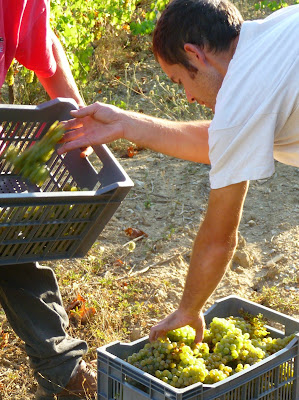
  You may recall I recently got to take part in a viognier harvest here in the Cevennes. Terroir makes a huge difference, whether it is in the Cevennes, the Bouche du Rhone, or Stellenbosch. After getting over its startling difference to French viognier, I loved the very full tasting, slightly peachy organic 2008 Viognier from small Topaz Estate, one of the so-called boutique, or garagiste, wineries.


 I have mentioned viognier
  Daniel Faure, the proprietor of
 The low-yield viognier is grown without any use of pesticides or chemical fertilizers at Puechcamp, all the more impressive given how notoriously sensitive to mildew this grape is. Having reached full ripeness, it is picked by hand and brought to the cave.
 For more on this increasingly popular varietal, check this Jancis Robinson


 At Perpignan, you forsake the highway and its views of the mighty Pyrenées mountains for the little D914, still winding southward. Take a deep breath (because now the holiday really begins). You are entering true Catalan territory, French-speaking still, but with a distinctly Spanish-inflected style. Along this bit of road, you are taken to the vertiginous edge of the Vermilion Coast, but then here even the vineyards are tucked into the very sea-edge (as in the photo below), and if you're anything like me, you come for the open spaces, dramatic views--and wine. Apparently others come for the nude beaches.


 But another essential distinction is rancio, which is what Banyuls often have in spades. Described as the taste of "nutty, oxidized fruit" (thank you,
  If you are interested in grape varieties, Grenache Noir is the principal one used, blended with Grenache Gris and Blanc for Banyuls, and Syrah and Mourvedre for Collioure.

 All tastings considered, this trip's winner has to be Domaine de Vial-Magnères; I went home with two cartonsful. If you're really interested, ask me--and I'll send you some notes on individual wines...
  I also went home with a bagful of these local artichokes (and fresh peas, and asparagus) from the Sunday market in Collioure. So I guess I did bring home some art after all--the kind best enjoyed with a mustardy, shalloty vinaigrette.

 The Delas house is gaining in popularity due to strong and steady improvements in the past few years; the resulting praise from Robert Parker hasn't hurt. Unfortunately the photo I took above highlights a bottle of white I was underwhelmed by, having found it a bit astringent. To the right sits a bottle of what we quite liked: their Les Challeys 2007, St. Joseph white. So refreshing and, well, flirty, I was already busy imagining summer afternoons on the terrace.
 I can say that we very much enjoyed the various Côte-Rôtie on offer by the gracious Levet family, pictured above. They have a small, independent operation, with a storefront in Ampuis itself. It was hard to choose, but we walked away with their 2006 Amethyste, and 2005, both Côte-Rôtie reds. Voluptuous and rich, with a lingering finish.


